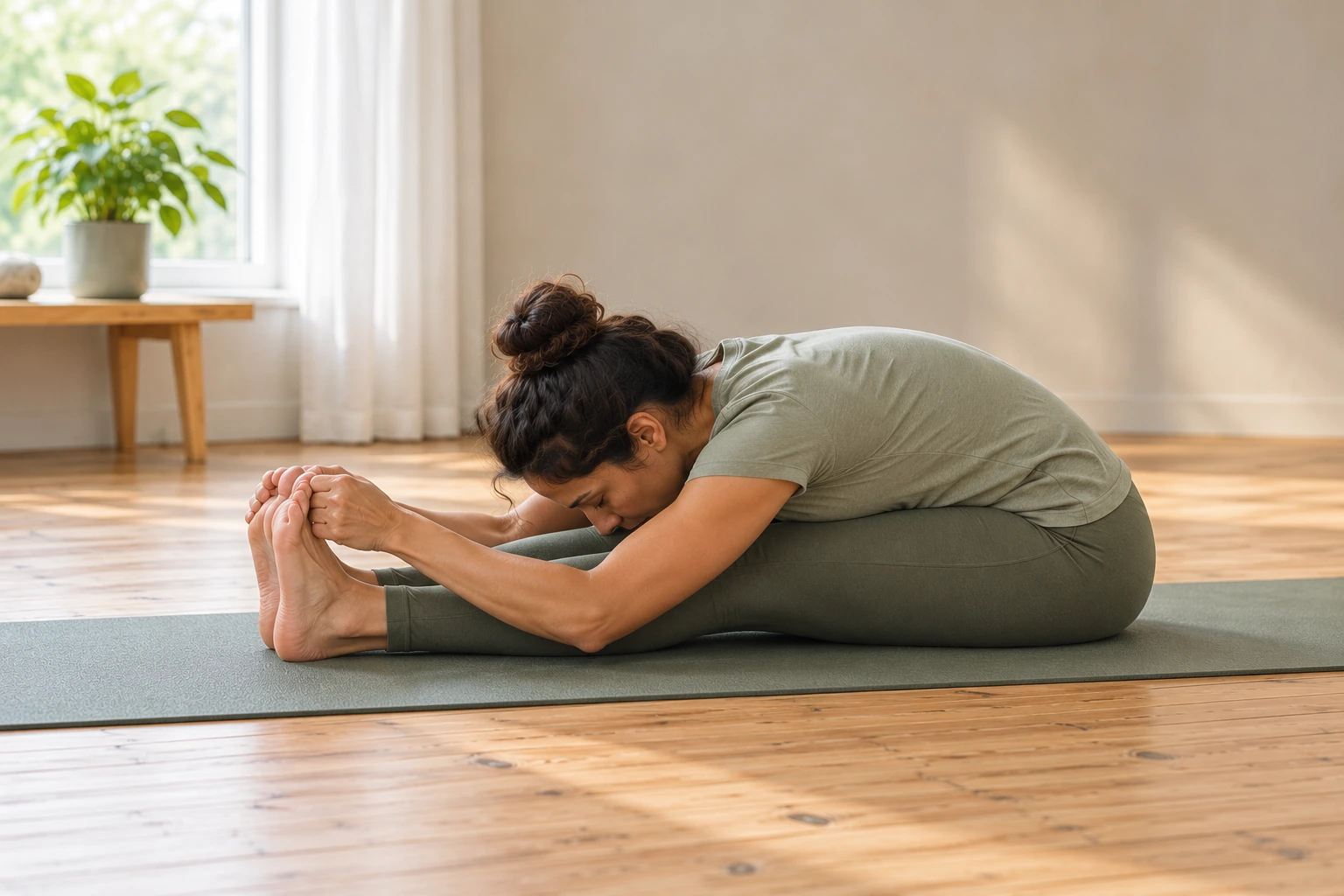
The shape of the pose
A fold over both legs; the handhold varies.
The A form is shown here: both legs extend straight ahead, the hands hold the big toes and the elbows bend as the torso folds over the legs. Other handholds may receive different letters in different teaching charts. A wrist-hold form is also shown below, without assigning a variant letter. Grips over the toes toward the soles and around the outer foot edges are also shown there.
The video shows one entry from upright Dandasana into Paschimottanasana A: the hands reach the big toes and the torso folds over the straight legs. The full vinyasa sequence is not shown. The ten-second clip specifies neither practice speed nor hold time.
What happens in the body?
The forward fold brings torso and legs closer through movement at hips and back. Reach depends on body proportions, mobility and the chosen shape. A strap bridges the distance to the feet; it should not pull the body beyond a range it can control.
More forms

Deep seated forward fold with two straight legs close together and one hand holding the opposite wrist beyond the soles.
The pelvis and legs rest on the mat as the torso folds along the thighs. The arms reach past the feet and connect through one hand encircling the opposite wrist.

Deep seated forward fold with straight legs and each hand reaching over the toes toward its corresponding sole.
The pelvis and legs rest on the mat while the torso folds along the thighs. Each hand reaches over the toe tips to meet the sole; the grip differs from holding only the big toe.

Deep seated forward fold with straight legs, fingers around the outer foot edges and thumbs at the big-toe base.
The seat and straight legs rest on the mat while the torso folds forward. The fingers enclose the feet from the outside and the thumbs meet the forefeet near the big-toe joints.

The seat and both heels rest on the mat. One belt passes around the forefeet, with one end held in each hand. The torso inclines slightly forward, the elbows remain bent and the hands stay short of the feet.
The belt bridges the distance between hands and feet. Adjust its length so that the shoulders can stay relaxed and the torso can remain controlled. It is not a handle for pulling the head toward the knees.
The older forward-fold passages describe direct foot or toe holds. They do not describe this belt setup. Here it is shown as a present-day adaptation, alongside the direct handholds, rather than assigned an ancient variant letter.
Adaptation and limits
This description identifies shape and context. Adaptations change the execution and should not be confused with every named variant in a traditional chart. Further teaching is needed to choose a suitable entry and exit.
Practising with care
If you have an injury or a medical condition, take medication, are pregnant or breastfeeding, or have another circumstance that may affect your practice, consult a qualified healthcare professional about suitable activities and necessary adaptations.
Learn new and demanding poses with a qualified yoga teacher. Adapt the range to your body and stop if you feel pain or dizziness. A short video illustrates movement; its length does not prescribe how long to hold a pose.
Headstands, shoulder stands and lotus are not starting poses for beginners. Injuries, balance problems or glaucoma are examples of reasons to assess suitability individually. Do not force a bind or use the body as leverage against the knee.
The pose in context
Haṭhayogapradīpikā 1.28 describes a seated forward fold with straight extended legs, the hands holding the fronts of the feet and the forehead towards the knees. The text uses the name Paschimatana. It describes the basic shape without today’s A–D labels or all handhold variations. Gheranda Samhita 2.23 also describes a toe hold and forward fold, without today’s variant letters.
Sources for this page
- Svātmārāma: Haṭhayogapradīpikā, with the Jyotsnā and Manobhilāṣiṇī commentaries (1895)1.28, p. 19 · Wellcome Collection
- Gheraṇḍa Saṃhitā — translation by Sris Chandra Vasu (1895)2.23, p. 14 · Wellcome Collection
Yoga forms and variations
These links compare teaching contexts and related shapes. Read the named form, supports and limits on this page before using a position.